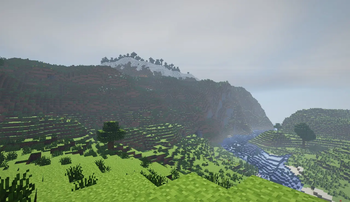

AuraLite Shaders
Lightweight, highly optimized OpenGL 4.6 shaders for Minecraft 1.20.1 featuring fly-through 3D volumetric clouds and LabPBR.
🆕 What's New in v1.0.5 — Expanded Localization
Version 1.0.5 is a localization-focused release that adds 10 new in-game languages, bringing the total to 69 supported locales. No shader logic, profile defaults, or rendering behavior was changed — this is a pure translation / metadata update on top of v1.0.4.
🌐 New Languages
The following fully-translated
.langfiles were added (every option name, value label, profile name and tooltip — 289 keys each, 100% key parity with the English source):Code Language Code Language gl_esGalician sw_keSwahili ga_ieIrish nn_noNorwegian Nynorsk gd_gbScottish Gaelic tt_ruTatar af_zaAfrikaans hy_amArmenian az_azAzerbaijani zh_hkCantonese (Hong Kong) - As with all non-English locales, the in-game ⚠ Translations may contain errors notice applies — some strings in rarer languages may be imperfect; compare with the English original if anything looks off.
🆕 What's New in v1.0.4 — Profile Rebalance, Translucent Blocks & Glass Rendering
Version 1.0.4 delivers a full quality-profile rebalance for smoother progression, introduces proper translucent block rendering for ice and glass, adds a dedicated Iris/Oculus translucent terrain pass, and fixes a cross-vendor GLSL compatibility issue.
🔄 Full Profile Rebalance
All six quality profiles (VERY_LOW → EXTREME) have been rebalanced for a smoother, more logical feature progression:
Profile Key Changes in v1.0.4 VERY_LOW Sun intensity lowered to Dim (1), underwater night set to Moonlit Pool for visibility. LOW Ambient brightness lowered, cozy lights disabled, Filmic tone mapping (ACES), underwater night set to Dim. Stars upgraded to Standard. MED Godrays now enabled (Fast quality) — this was the biggest missing piece in the sweet-spot preset. PBR strength raised to Standard. Meteor frequency normalized. HIGH SSAO now enabled (Subtle) — contact shadows appear at this tier. Godrays bumped to Balanced. Moon intensity lowered to Standard. ULTRA Godrays raised to High. TAA strength at Balanced. EXTREME Water wave scale pushed to Stormy. Underwater night set to Pitch Dark for maximum survival realism. Photographic (AgX) tone mapping. 🧊 Split Ice & Glass Block Rendering
- Regular ice (
minecraft:ice, block ID 10005) now renders with its actual texture and semi-transparency instead of being fully opaque. Transparency scales with theWATER_TRANSPARENCYsetting (Clear / Balanced / Deep). - Packed ice, blue ice, and frosted ice (block ID 10007) are now rendered opaque with texture — distinct from regular ice so the visual difference is clear.
- All glass blocks and panes (block ID 10008), including every stained-glass variant and tinted glass, now render with their actual texture and proper transparency. Glass opacity scales with
WATER_TRANSPARENCY. This eliminates the old "invisible glass" problem where glass blocks disappeared against bright skies. - Both ice types and glass are handled by the new
gbuffers_terrain_translucentpass, ensuring correct rendering on Iris/Oculus split-translucent pipelines.
🪟 New Translucent Terrain Pass (
gbuffers_terrain_translucent)- A new
gbuffers_terrain_translucent.fsh/.vshshader pair was added. This pass handles water, ice, glass, and nether-portal blocks in a single Iris/Oculus-compatible translucent terrain path. - Mirrors the existing
gbuffers_water.fshlogic so translucent blocks render identically regardless of whether the loader uses a unified or split translucent G-buffer path. - Nether portal plasma, ice Fresnel, glass opacity, and water Fresnel/ripples all route through this pass.
🛠️ GLSL Compatibility Fix
- Replaced all
fma()calls with direct multiply-add expressions across every shader file. Thefma()intrinsic, while correct on most modern GPUs, caused compilation failures on certain drivers (particularly older Intel iGPUs and some Mesa versions). The replacementa * b + cexpressions are mathematically equivalent and compile universally.
- Regular ice (
🆕 What's New in v1.0.3 — Anti-Aliasing & PBR Performance
Version 1.0.3 adds configurable spatial anti-aliasing (FXAA / SMAA) and a PBR render distance control that skips expensive Cook-Torrance specular calculations on distant terrain.
🖼️ Spatial Anti-Aliasing (FXAA / SMAA)
SPATIAL_AA_MODE— new toggle in the[Post-Processing]menu with 3 modes:- Off — no spatial AA (TAA-only or nothing).
- FXAA — Fast Approximate AA. Sobel gradient-directed edge detection with conservative blend weights. Cheap and effective.
- SMAA — Subpixel Morphological AA. Combines luminance Sobel gradient with depth discontinuity detection for superior edge detection on geometry where luma contrast is low. Slightly more expensive than FXAA.
- Both modes operate in linear space before tone mapping and are conservative enough to avoid washing out the image (max blend weight 0.15–0.18, high edge thresholds).
- Freely combinable with TAA (composite1 pass) for temporal + spatial smoothing.
- Added to all 6 quality profiles: VERY_LOW=Off, LOW/MED=FXAA, HIGH/ULTRA/EXTREME=SMAA.
⚡ PBR Render Distance
PBR_DISTANCE— new setting in the[Lighting Settings]menu with 4 levels:- Near (16m) — PBR specular only on very close surfaces. Maximum GPU savings.
- Standard (48m) — balanced distance. Default for LOW/MED profiles.
- Far (128m) — extended range. Default for HIGH/ULTRA profiles.
- Unlimited — no distance limit. EXTREME profile only.
- Beyond the fade range, the entire Cook-Torrance BRDF block (GGX distribution, Smith geometry, Fresnel-Schlick) is completely skipped via early-out — no wasted ALU on sub-pixel specular.
- Fade is smooth (
smoothstepbetween start and end distance) to avoid visible pop-in.
🌐 Localization
- Full English and Russian localization for both new settings (option names + value labels).
- Other language files fall back to English labels.
🌿 Foliage Subsurface Scattering (also finalized in v1.0.3)
FOLIAGE_SSS— toggle in the[Foliage Settings]menu. Enables light bleeding through leaves and plants when looking toward the sun, plus a soft wrap term for the shaded side. Controlled per-profile (enabled from MED upward by default). Uses material ID tagging ingbuffers_terrainand a dedicated SSS pass incomposite.fsh.- Added to all quality profiles (VERY_LOW → EXTREME) with the
!FOLIAGE_SSSorFOLIAGE_SSSflag. - Full English + Russian localization strings added.
🆕 What's New in v1.0.2 — Foliage Subsurface Scattering
Version 1.0.2 adds realistic subsurface scattering (SSS) for vegetation. Leaves, grass, and plants now look more translucent and alive when light shines through them.
🌿 Foliage Subsurface Scattering (
FOLIAGE_SSS)- New toggle in the
[Foliage Settings]menu. - Light bleeding from the back side of foliage + soft wrap term on the unlit side.
- Enabled from MED profile upward by default (disabled on VERY_LOW/LOW for maximum FPS).
- Integrated with existing PBR pipeline using material ID tagging (
matID10001–10004) ingbuffers_terrain. - Full English and Russian localization.
This is a focused, low-cost visual enhancement that makes forests and plants feel much more natural under direct sunlight.
- New toggle in the
🆕 What's New in v1.0.1 — Stability, HDR Bloom & Photographic Tone Mapping
Version 1.0.1 is a focused hotfix on top of v1.0.0 that addresses five edge-case rendering issues and introduces a new cinematic tone-mapping curve with lightweight HDR bloom.
🛠️ Bug Fixes
- TAA history acceptance threshold. Added
historySample.a < 0.99guard incomposite1.fshso uninitialised or stale history buffers (e.g. right after shader reload or resolution change) are rejected instead of causing ghosting. - Vibrancy math.
applyVibrancyinfinal.fshnow correctly handles negative saturation values — oversaturation works as intended rather than relying on undefined GLSLmixextrapolation followed by hard clamping. - SSR normal NaN guard. Added
length(N) > 0.5check beforetraceSSR()so invalid normals from edge pixels are silently skipped instead of producing black reflections. - SSR near-field trace precision. Minimum raymarch step lowered from
1.0to0.3view-space units, dramatically improving hit rate on close surfaces (ripples, shallow pools, wet stone). - Meteor moon-brightness curve.
gbuffers_skybasic.fshnow usescos²(phase × π/8)— identical togetMoonPhaseBrightness()incomposite.fsh— so moon washout is physically consistent.
🎨 Visual Enhancements
- HDR Bloom (v1.0.1). Cheap single-pass 3×3 neighbour blur for overbright pixels (luminance threshold 0.75). Naturally affects sun/moon disks, lava, portals, bright specular highlights, and torches — without smearing the entire scene or requiring extra render targets.
- Photographic (AgX-like) Tone Mapping (v1.0.1). A new
CONTRAST = 4option infinal.fshprovides a sigmoidal tone curve with natural highlight chromatic attenuation, soft toe, and lifted blacks — giving a cinematic, non-clipped look that keeps foliage saturation under control while handling extreme brightness gracefully. - EXTREME profile updated. Now uses
CONTRAST=4(Photographic/AgX-like) instead ofCONTRAST=3for cinematic highlight handling.
- TAA history acceptance threshold. Added
🆕 What's New in v1.0.0 — Meteor Showers & Finalized Reflection Pipeline
Version 1.0.0 builds on the volumetric aurora work from v0.3.0 and introduces the first v1.0.0 source snapshot in this repository. The update adds a physically-inspired meteor system to the night sky, finalizes the modern SSR path for reliable Iris compatibility, and refreshes the documentation so the project now correctly points to the
shaders v1.0.0/folder.☄️ Physically-Based Meteors / Falling Stars
- True great-circle sky arcs. Meteors are rendered as moving arcs on the celestial sphere instead of flat 2D streaks, so showers converge toward a shared radiant like real meteor photography.
- Ablation-based brightness curve. Each meteor rises, peaks, and fades with a bell-shaped light curve inspired by atmospheric entry.
- Blackbody plasma colouring. Meteor heads are tinted with the same Kelvin-based colour pipeline used by AuraLite's sun/moon lighting, giving physically consistent warm-to-white fireball tones.
- Moonlight washout and weather attenuation. Faint meteors are suppressed by bright moon phases, rain, and daytime sky brightness, improving realism and avoiding visual clutter in poor visibility.
- Persistent trains on bright fireballs. The strongest events leave a short-lived glowing ionization trail, including a subtle green oxygen-style tint on the lingering train.
- Available in both Overworld and The End. Overworld meteors respect moonlight and atmosphere; End meteors render against the permanent night sky without moon washout.
🪞 Finalized v1.0.0 SSR / Water Reflection Path
colortex6fully removed from the reflection workflow. The older MRT export path was retired;final.fshnow reads normals directly fromcolortex2and roughness fromcolortex1, matching AuraLite's already-working PBR data path.- Depth-based water-surface detection. Water is identified by comparing
depthtex0anddepthtex1, making reflections robust on Iris paths where water G-buffer writes may be inconsistent. - More stable water normals. Reflection normals are reconstructed from neighbouring depth samples and then perturbed with coherent world-space ripple gradients, reducing faceting and torn reflections.
- Cleaner post-pass reliability. The reflection pipeline now lives entirely in the final post-processing pass, simplifying the frame graph and avoiding loader-specific MRT issues.
🎛️ New Sky Settings & Profile Integration
- New configurable options:
SHOOTING_STARS,SHOOTING_STARS_FREQUENCY, andSHOOTING_STARS_BRIGHTNESS. - Shooting stars are disabled on the lightest presets and enabled from MED upward through the normal profile system.
- English and Russian UI text was expanded for the new night-sky controls, while other language files continue to fall back safely.
Нет описания изменений
Нет описания изменений
Нет описания изменений
Нет описания изменений
Нет описания изменений
Нет описания изменений
Нет описания изменений
Нет описания изменений
Нет описания изменений
Нет описания изменений