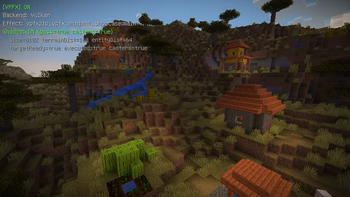

Vulkan PostFX
Experimental VPFX shader pack loader and post-processing framework for Minecraft’s modern Vulkan-based rendering path.

Vulkan PostFX
Vulkan PostFX, also known as VPFX, is an experimental VPFX shader pack loader and post-processing framework for Minecraft’s modern Vulkan-based rendering path.
It allows external VPFX shader packs to add screen-space visual effects such as color grading, vignette, tone mapping, highlight compression, cinematic look adjustments, depth-based effects, and early shadow-depth experiments.
This project is still experimental, but it already supports ZIP-based VPFX shader packs through Minecraft’s resource pipeline.
Start here
For the best first experience, install both:
- Vulkan PostFX — the loader and runtime
- VPFX Minimal Showcase — the official minimal example pack
Vulkan PostFX is not a full Iris / OptiFine replacement.
The goal is to build a new VPFX workflow for Minecraft’s Vulkan rendering path, starting from reliable external pack loading and gradually moving toward a more capable shader runtime.
What Vulkan PostFX does
Vulkan PostFX currently focuses on:
- external ZIP-based VPFX shader pack loading
- graph-based post-processing configuration
- runtime resource pack materialization
- runtime resource pack injection
- external post-chain execution
- scene color sampling
- scene depth capture
- experimental shadow depth input
- diagnostics for broken packs
- early native runtime experiments
This means Vulkan PostFX is already executing a real external VPFX pack pipeline, not just parsing ZIP files.
external ZIP shader pack
  -> VPFX manifest / graph validation
  -> runtime resource pack materialization
  -> Minecraft resource system injection
  -> external post-chain execution
Current features
External VPFX pack loading
Vulkan PostFX supports ZIP-based VPFX shader packs containing files such as:
pack.json
post_effect/main.json
shaders/<path>.vsh
shaders/<path>.fsh
Shader references use the following format:
<pack_id>:<path>
For example:
vpfx_minimal_showcase:composite/final
which resolves to:
shaders/composite/final.vsh
shaders/composite/final.fsh
Shader paths are not limited to a fixed post/ directory layout.
Runtime namespace rewriting
External packs are rewritten into isolated runtime namespaces to reduce conflicts with built-in resources and other packs.
This allows VPFX packs to behave more like external visual packages while still being routed through Minecraft’s resource system.
Runtime resource pack injection
External ZIP contents are materialized into runtime resource packs during startup / resource reload and injected into Minecraft’s client resource system.
This is one of the core parts of the VPFX loading pipeline.
External post-chain execution
Vulkan PostFX can load external post chains through Minecraft’s ShaderManager and execute them through the current minecraft_postchain backend.
The current stable execution path is still based on Minecraft’s post-chain system.
Scene, depth, and shadow inputs
Current VPFX runtime inputs include:
minecraft:scene_color
vulkanpostfx:scene_depth
vulkanpostfx:shadow_depth
minecraft:main
These inputs are used for screen-space effects, depth-based experiments, and shadow-depth debugging.
Failure diagnostics
When a VPFX pack fails to load or execute, Vulkan PostFX can generate diagnostic information for issues such as:
- missing shader files
- invalid graph targets
- sampler mismatches
- shader path errors
- external target problems
- pipeline creation failures
If a pack is broken, the goal is to make the failure understandable instead of silently failing.
Experimental native runtime
Vulkan PostFX is gradually moving beyond Minecraft’s default post-chain backend.
Current experimental native runtime progress includes:
- native runtime support checks
- resource mapping dry-runs
- same-target hazard detection
- transient color target planning
mainTarget -> transientColorcopy validation- builtin native fullscreen passthrough draw
- opt-in diagnostic mode for testing the native passthrough path
The current experimental native path can be summarized as:
minecraft:main
  -> transientColor
  -> builtin native fullscreen passthrough
  -> minecraft:main
This is still experimental and opt-in.
User VPFX shaders are not fully executed natively yet.
Current sample pack
VPFX Minimal Showcase
The official minimal example pack demonstrates:
- VPFX
pack.json - graph-based post-effect configuration
- non-
post/shader paths minecraft:scene_colorsamplingminecraft:mainoutput- basic screen-space look adjustment
It is the recommended starting point for testing Vulkan PostFX.
Usage
1. Place a VPFX shader pack
Put the VPFX shader pack ZIP into the shaderpacks folder of your Minecraft instance.
For development runs, this is usually:
run/shaderpacks/
2. Select the active pack
Edit the config file:
config/vulkanpostfx.json
For development runs, this is usually:
run/config/vulkanpostfx.json
Example:
{
  "active_pack_id": "vpfx_minimal_showcase"
}
3. Launch the game
When the client starts, Vulkan PostFX will:
- scan available VPFX ZIP packs
- parse
pack.json - select the active pack
- validate the VPFX graph
- materialize runtime resources
- inject runtime resources into the client resource system
- attempt to load the corresponding external post chain
4. Toggle effects
By default:
F8
toggles the current VPFX effect.
F9
toggles the experimental shadow depth debug view.
Architecture overview
Current external pack path:
[shaderpacks/*.zip]
        |
        v
[VPFX Manifest / Graph Parse]
        |
        v
[Active Pack Selection]
        |
        v
[Runtime Materialization]
        |
        v
[Runtime Resource Pack Injection]
        |
        v
[minecraft_postchain backend]
        |
        v
[External VPFX Post Chain Execution]
Experimental native runtime path:
[VPFX Native Runtime]
        |
        v
[mainTarget -> transientColor]
        |
        v
[builtin native fullscreen passthrough]
        |
        v
[minecraft:main]
What this is
Vulkan PostFX is currently best described as:
- a working VPFX ZIP shader pack loader
- a post-effect based execution backend
- an experimental Vulkan shader runtime foundation
- an early native runtime research project
It is designed for Minecraft’s modern Vulkan rendering path and for VPFX-specific shader packs.
What this is not
Vulkan PostFX is not yet a mature drop-in replacement for Iris or OptiFine.
Most Iris / OptiFine shader packs cannot be used directly without porting.
Traditional shader pipeline compatibility is not the current focus of the first development stages.
Current limitations
Vulkan PostFX is still alpha software.
The following traditional shader pipeline components are not fully supported yet:
gbuffers_*- full
shadow.*compatibility - full
composite.*compatibility - screen-space reflections
- volumetric fog
- natural cloud rendering
- material-aware lighting
- dimension-specific shader routing such as
world1/andworld-1/ - direct Iris / OptiFine shader pack compatibility
Native runtime limitations
The native runtime currently supports only an experimental builtin fullscreen passthrough path.
It does not yet support:
- user shader native execution
- multi-pass native execution
- custom native render targets
- native scene depth input
- native shadow depth input
- compute shaders
- native volumetric lighting
- native cloud rendering
- RT / path tracing
Development roadmap
The recommended development direction is:
- improve VPFX pack authoring workflow
- stabilize effect loading, switching, reload, and fallback behavior
- continue validating screen-space look layers
- improve final-pass translation quality
- implement user shader native execution
- introduce native multi-pass graphs
- expand depth and shadow support
- eventually explore lighting, clouds, and RT-lite experiments
Design philosophy
The core idea of Vulkan PostFX is not to force every traditional shader-pack semantic into Vulkan at once.
Instead, the project follows a staged approach:
make external VPFX packs actually run
  -> improve visual fidelity
  -> stabilize the runtime
  -> expand graph execution
  -> gradually bring back advanced visual features
In other words:
first establish a truly executable external shader chain, then gradually bring back the visual logic that matters.
Notes
This is a fast-evolving experimental project.
If you are looking for a ready-made, fully compatible Iris / OptiFine replacement, Vulkan PostFX is not there yet.
But if you care about:
- Minecraft’s Vulkan rendering path
- VPFX shader pack experiments
- external ZIP shader pack loading
- modern runtime resource pack injection
- scene / depth / shadow based post effects
- experimental native render graph runtime development
then this project is built exactly for that.
Update policy
Vulkan PostFX is expected to follow Minecraft snapshot updates quickly.
The project may update weekly, or more often when Minecraft snapshots or VPFX runtime milestones require it.
